Irrigation in agriculture is the artificial application of water to the land. Irrigation has been a key aspect of agriculture for over 5000 years and has been developed by many cultures around the world. It is generally used in the areas where rainfall is irregular or dry times or drought is expected.
Types of irrigation – There are different types of irrigation practised for improving crop yield. these are based on type of soil, climates, crops and resources. the main types of irrigation include as follows.
- Surface irrigation– in this system no irrigation pump is involved . here water is distributed across land or gravity.
- Localized irrigation – In this system water is applied to each plant through network of pipes under low pressure.
- Sprinkler irrigation – water is distributed from a central location by overhead high pressure sprinklers or from sprinklers from the moving platform.
- Drip irrigation – in this type drop of water are delivered near the roots of plants. this type of irrigation rarely used as it require more maintenance.
- Sub irrigation – water is distributed through a system of pumping stations gates , ditches and canals by raising the water bodies.
- Manual irrigation- this is a labour intensive and time consuming system of irrigation system . here the water is distributed through watering cans by manual labour.
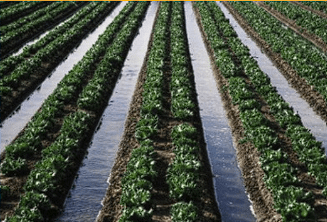
Importance of Irrigation
The importance of irrigation can be explained in the following points:
- Insufficient and uncertain rainfall adversely affects agriculture. Droughts and famines are caused due to low rainfall. Irrigation helps to increase productivity even in low rainfall.
- The productivity on irrigated land is higher as compared to the un-irrigated land.
- Multiple cropping is not possible in India because the rainy season is specific in most of the regions. However, the climate supports cultivation throughout the year. Irrigation facilities make it possible to grow more than one crop in most of the areas of the country.
- Irrigation has helped to bring most of the fallow land under cultivation.
- Irrigation has stabilized the output and yield levels.
- Irrigation increases the availability of water supply, which in turn increases the income of the farmers.
Quality of Irrigation Water
All natural waters used for irrigation contains inorganic salts in solutions which are derived originally from the rocks or solid phase material through which water percolates. The most common dissolved constituents are chlorides, sulphates and bicarbonates of Ca, Mg and Na. The concentration and proportion of these
salts determine the suitability of water for irrigation. Other constituent such as B, Li, F or other ions, which have a toxic effect on plants, may occur in lesser amounts in irrigation water. If water used for irrigation contains excessive quantities of the constituents noted above, it might affect the
growth of plants in three ways viz.,
(a) As a result of adverse changes in the physical characteristics of the soil,
(b) The increased osmotic pressure of the soil solution may decrease the physiological availability of moisture to plants
(c) Accumulation of certain ions in the soil solution may have a specific toxic effect upon the physiological processes of the plant.
Other constituent such as B, Li, F or other ions, which have a toxic effect on plants, may occur in lesser amounts in irrigation water.
PROBLEMS WITH POOR QUALITY WATER :
- Extraction of Water: If excess soluble salts of irrigation water accumulated in crop root zone, crop has difficulty in extracting enough water, root growth is also suppressed. increasing the difficulty of water uptake. Salinity stress in plants is often called physiological drought. Due to reduced uptake of water and other effects, yields are reduced. The reduction in yield due to salinity is more in warm climate than cool climate.
- Soil permeability: Soil permeability is reduced due to the deflocculation effect of sodium. If permeability is reduced, infiltration of water into and through the soil is reduced. Adequate root penetration is inhibited due to the presence of impermeable soil layer caused by CaCO3 and high exch. Na % Crusting of seed bed, Water logging, reduced oxygen and nutrient supply to the crops are the problems due to high sodium content relative of Ca & Mg.
- Toxicity Symptoms: More uptake of B, Cl, Na, sulphate and bicarbonate by plant creates toxicity problems. Vegetative growth decrease as osmotic pressure of the soil solution increases. Osmotic pressure causes water to move into the solution with the highest concentration. Reduction in growth takes place even without any external toxic symptoms.
Sub- surface irrigation:
- water is applied beneath the ground by creating and maintaining an artificial water table at some depth, usually 30-75 cm below the ground surface.
- Moisture moves upwards towards the land surface through capillary action
- Water is applied through underground field trenches laid 15-30 m apart
- Open ditches are preferred because they are relatively cheaper and suitable to all types of soil.
- The irrigation water should be of good quality to prevent soil salinity
Advantages :
- Minimum water requirement for raising crops
- Minimum evaporation and deep percolation losses
- No wastage of land
- No interference to movement of farm machinery
- Cultivation operations can be carried out without concern for the irrigation period
Disadvantages :
- Requires a special combination of natural conditions.
- There is danger of water logging
- Possibility of choking of the pipes lay underground.
- High cost.
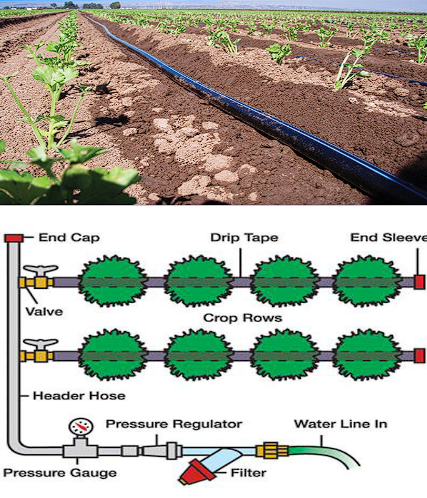
DRIP IRRIGATION SYSTEM:
- Drip or trickle irrigation is one of the latest methods of irrigation.
- It is suitable for water scarcity and salt affected soils.
- Water is applied in the root zone of the crop
- Micro-tubes are also used in a drip lateral. They are used mainly in the following ways (1) as emitters (2) as connectors, (3) as pressure regulators
Advantages:
- Water saving – losses due to deep percolation, surface runoff and transmission are avoided. Evaporation losses occurring in sprinkler irrigation do not occur in drip irrigation.
- Uniform water distribution
- Application rates can be adjusted by using different size of drippers
- Suitable for wide spaced row crops, particularly coconut and other horticultural tree crops
- Soil erosion is reduced
- Better weed control
- Land saving
- Less labour cost
Disadvantages:
- High initial cost
- Drippers are susceptible to blockage
- Interferes with farm operations and movement of implements and machineries
- Frequent maintenance
- Trees grown may develop shallow confined root zones resulting in poor anchorage
CRITICAL PERIOD FOR IRRIGATION :
there are certain growth stages in crops. they require assured supply of irrigation water at these stages. these are referred to as critical stages for crops. if water is not supplied at these stages yield is badly reduced. for herbaceous crops germination is critical stage. varying from crop to crop, head development for cole crops , pod development for beans, tuberization for potato, bulb development for onion garlic, flower development for flori-crops, fruit setting and development for fruit crops etc. are critical stages.

 agriculture and health